


- Distance and Time required: 1,5km | 0.45
- Elevation gain: 58
- Starting Point: Parking behind the Church of Sovilla in Via Monsignor della Casa
- Short description: A short and easy walk for the whole family to discover the Abbey of Saint Eustace, rising majestically on the Montello hill. Inside, you'll also find a small museum worth visiting.
- Stroller/Wheelchair accessible: No

The walk
The morning is beautiful, and it almost feels wrong to stay indoors—so we go for a short adventure and decide to visit the Abbey of Sant’Eustachio in Nervesa. It's the perfect chance to enjoy a gentle, easy walk and discover a lovely corner of the Montello hills.
 Climb up to Sant Eustachio
 Vineyard
On the left, near the vineyard, we spot a round hill that makes us think of an ancient *castelliere*—a human settlement from about 3,000 years ago.
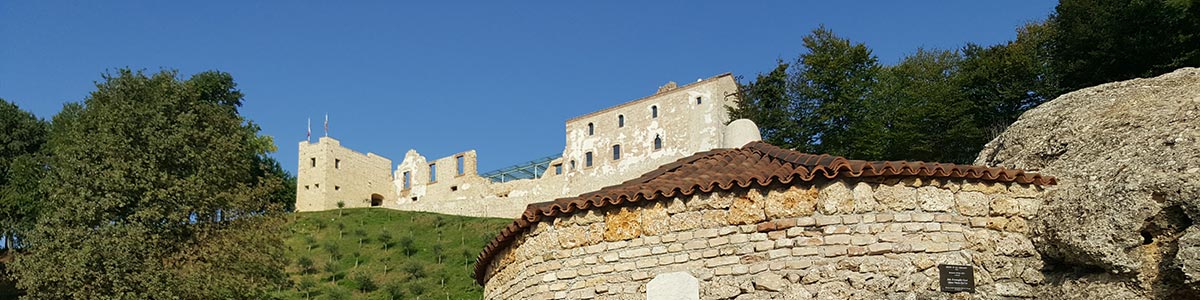
About halfway through, we take the path on the left that leads us among olive trees to the Hermitage of San Girolamo, where a statue of the saint is kept. From here, the view of the Abbey is absolutely stunning.
 Hermitage of San Girolamo
 Inside the Hermitage
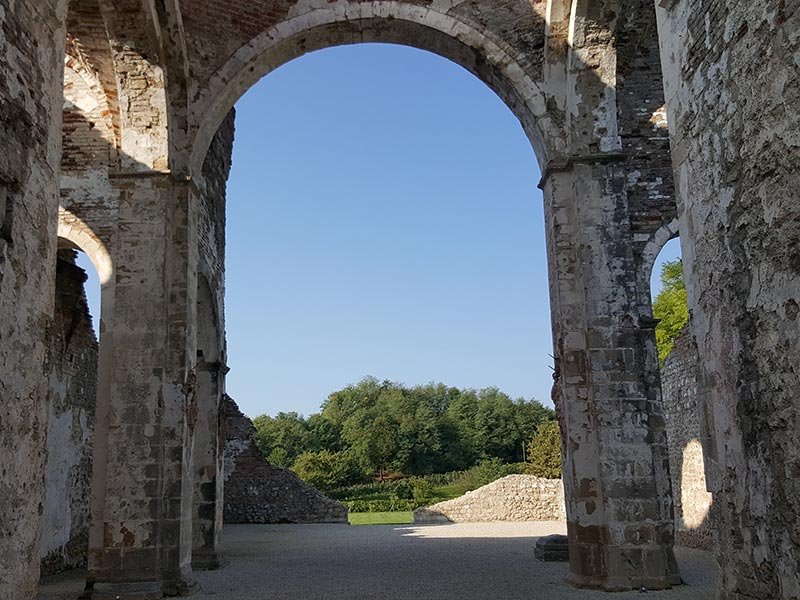
We return to the main trail and soon reach the top, passing through the entrance tower. You can wander through the ruins of the Abbey of Sant’Eustachio—climb the tower for a great view of the surrounding plains, and explore what’s left of the cloisters and the church nave.
 Entrance Tower
 The medieval Wall
After our “architectural” break, we head to the column in front of the Abbey, then take the trail just below it going right. We pass through a pine grove and reach a white gravel road—here we go right again, walking alongside the vineyard.
 Abbey of Sant'Eustachio
 Behing" the Abbey
We pass along the northern wall of the Abbey, which gives us a fresh angle to admire this imposing building. From here, it’s a short descent back to the car.
Photos




Track Gps
What to see
The Hermitage of Saint Gerolamo
The Abbey of Saint Eustachio: an important Benedictine monastery founded by the Collalto family in the 11th century and suppressed in the 19th century. Between the 16th and 17th centuries, it became a vibrant cultural center that attracted many famous writers — among them, Monsignor Della Casa, who wrote the famous “Galateo” here.
The small on-site museum
Refreshment Point
Inside the Abbey, there’s a small bar where you can take a relaxing break and enjoy a few local snacks and drinks (“cicchetti”).
Curiosities
Inside the museum, you’ll find the Papal Bull that officially “closed” the Abbey in 1521. It returned home from England thanks to archivist Christopher Dawkins of Felsted School. The document had likely ended up across the Channel with a British soldier stationed on the Montello front during World War I.